
Team Baseline Assessment
Every participant takes the same structured AI-led voice assessment. You get a team capability map across ten AI-native areas - where the team is already AI-first, and where practice lags behind the tooling you pay for.
Impact-Site-Verification: 7aabcb1a-0a22-4299-b26c-e6cbb9b275a6
Ten AI-Native Engineering Areas,
One Honest Baseline, One Path to AI-First
AI-First Path assesses how your engineers and experts actually build with AI - agentic engineering practice, system design and product thinking - then closes the gaps with hands-on corporate trainings and always-on mentorship. Our CTO & Principal Engineer Network reviews every assessment, and a re-assessment shows what actually moved.
Every team says it is adopting AI. Very few can tell you who is already AI-first - or what to train next.
Seat licences for coding agents do not change how a team ships. What changes it is knowing, per engineer, whether they orchestrate agents, gate AI code review, sandbox what an agent may touch - and whether the system they design around all of it holds up in production. AI-First Path measures exactly that, from what people actually say in a structured voice assessment - not from self-ratings or quiz scores.
Then we train precisely the gaps the evidence shows, mentor every expert between sessions, and re-assess against the same rubric - so the lift is visible, not assumed.
No evidence, no score. Every rated area cites a verbatim quote from the expert's own assessment. Areas the conversation never reached come back marked Unverified - never guessed, never padded. Every assessment is reviewed by our CTO & Principal Engineer Network, and it is used for one thing only: development. It is never shared with other companies or used for hiring.
§ 01The Thesis
Frontier models can already plan, write, review and ship production code. What is missing is the human layer - engineers and experts who work AI-first, with the system design judgment to know what to delegate to an agent, what stays deterministic, and what still needs a person in the loop.
That practice does not arrive with a tool rollout. It is learned - and it can be measured. Teams that treat AI-first as a skill to assess and train pull ahead of teams that treat it as a licence to buy.
§ 02The Shift
AI exposure is highest across technology, management, finance and legal work - and the people who redesign those functions around AI will define the next decade. Proven AI-first engineers are the scarcest profile on the market.
The faster path is already on your payroll: engineers and experts who know your systems, your customers and your constraints. What they need is an honest baseline, training aimed at their real gaps, and a way to show the progress.
AI-First Path is the assessment and training layer for this transition - AI scores AI-first practice from real assessment evidence, our CTO & Principal Engineer Network reviews every result, and our trainings and mentors close the gaps until the next assessment proves it.
Operating thesisEvery participant takes the same structured AI-led voice assessment. You get a team capability map across ten AI-native areas - where the team is already AI-first, and where practice lags behind the tooling you pay for.
Hands-on sessions led by practitioners who ship agent systems themselves - built from your team's measured gaps and around your stack and workflows. Coding agents, specs and skills, orchestration, AI code review, MCP, oversight and system design.
Every participant keeps a 24/7 AI Expert Mentor grounded in their own scorecard, so practice continues on real work between sessions - not just in the workshop room.
A re-assessment on the same fixed anchors shows what moved, per area and per team - exportable as a PDF report for engineering leadership and L&D. Individual scorecards stay with each expert; you see the team picture.
Every module trains one area of the AI-native scorecard, so what is taught is exactly what is measured. Teams do not take all ten by default - the baseline decides which modules matter most, in what order, and for whom.
Working with Claude Code, Codex and similar agents on real tasks: delegation, review loops, and knowing when the agent is the wrong tool.
Writing specs agents can execute, and turning repeated work into reusable skills, prompts and project conventions the whole team shares.
Multi-step and multi-agent workflows, context selection and compaction - giving each agent exactly what it needs to know at each step.
Reviewing AI-written code at speed, evals and regression gates, and the checks that decide whether AI output is allowed to ship.
Connecting agents to internal systems, APIs and data through MCP and tool interfaces - with permissions designed in, not bolted on.
Sandboxes, scoped credentials and approval points: deciding what an agent may touch, and where a person stays in the loop.
Spreading what works across the team: shared workflows, internal enablement, and bringing sceptical colleagues along on evidence.
Architectural judgment when agents are part of the system: what stays deterministic, failure modes, cost, latency and observability.
Owning outcomes when an agent wrote the code, building personal feedback loops, and keeping pace as models and tools change monthly.
Explaining AI-assisted work, its risks and its limits to product, leadership and customers - and setting expectations that hold.
A 45-60 minute AI-led voice conversation about how you really work - your agentic AI practice, system design decisions and product thinking. It adapts to what you claim and follows up where the evidence is thin.
Ten areas scored 0-10, each backed by a verbatim quote from your own assessment, with a level placement from L3 to L8+. Anything the conversation never reached comes back Unverified - never estimated.
Every scorecard is reviewed by our CTO & Principal Engineer Network - agentic AI builders with strong software engineering backgrounds - so your feedback comes from people who ship this for a living.
A concrete learning plan built from your gaps: which areas to work on first, which training modules fit, and what evidence would move each score at your next assessment.
Always-on chat and voice mentor for expertise coaching, workflow-transformation advice and career direction - grounded in your own scores, not generic tips.
No hiring, no recruiters, no profile visible to other companies. Your results are for your development; you decide if anyone else sees them, and you can delete everything at any time under GDPR Article 17.
Becoming AI-first does not mean everyone becomes the same engineer. These are the ten roles AI-first teams are forming around, and each answers a different question in production. Your assessment shows which path you are closest to today - and which areas to train to grow into the next one. Read across for one role; read down a column to compare all ten.
| Role & mission | The question it answers | Core responsibilities | Agent orchestration | Production focus |
|---|---|---|---|---|
| 01 Agentic AI Engineer Builds agents that complete multi-step tasks. | “How can the agent complete this task with appropriate autonomy?” | Implements planning, tool use, business logic, memory and human handoffs. | Designs task-specific agent loops, delegation and coordination. | Task success, correct actions, bounded autonomy and recovery from failures. |
| 02 Forward Deployed AI Engineer Delivers working AI solutions inside customer environments. | “How do we solve this customer’s problem and get the solution adopted?” | Discovers requirements, integrates customer systems, customizes solutions and deploys them. | Adapts workflows to customer processes, permissions and existing infrastructure. | Customer outcomes, adoption, time to value and operational handover. |
| 03 AI Harness Engineer Builds the execution environment around models and agents. | “What enables the agent to work effectively, within controlled boundaries?” | Builds tool execution, session management, checkpoints, sandboxing and feedback mechanisms. Anthropic on harness design | Implements execution loops, stopping conditions, retries and resumable sessions. | Predictable execution, isolation, recoverability and effective long-running work. |
| 04 AI Evals Engineer Produces trustworthy evidence of AI quality and limitations. | “How do we know this change improves behavior without introducing regressions?” | Builds datasets, scoring rubrics, graders, repeatable experiments and regression gates. Anthropic on agent evals | Evaluates tool choices, handoffs, trajectories and final outcomes; rarely owns business orchestration itself. | Regressions detected, uncertainty quantified, release decisions informed by evidence. |
| 05 Context Engineer Gives models the right information at the right time. | “What should the agent know at this step?” | Designs retrieval, instructions, memory, context selection, compaction and information provenance. Anthropic on context engineering | Controls the information passed between steps and agents, including context isolation. | Relevant, fresh, permission-aware information within token and latency budgets. |
| 06 AI Product Engineer Owns useful AI-powered product experiences end to end. | “What should we build so users get meaningful value?” | Combines product discovery, UX, full-stack development, model integration and experimentation. | Builds or integrates agent workflows when they improve the product; agents are optional. | User outcomes, adoption, experience quality, latency and cost. |
| 07 AI Agent Platform Engineer Provides reusable infrastructure for many agents and teams. | “How can teams build and deploy agents consistently, at scale?” | Builds shared APIs and SDKs, deployment services, registries, access controls and tenant isolation. | Provides the shared scheduling, state storage and execution services application teams build on. | Platform availability, scalability, governance and developer productivity. |
| 08 AgentOps / AI Reliability Engineer Keeps deployed agents dependable and operationally manageable. | “Are agents working reliably in production, and what happens when they fail?” | Implements tracing, alerts, service objectives, incident response, rollback and cost monitoring. LangSmith observability docs | Monitors executions; diagnoses loops, stalled runs, retry storms and broken dependencies. | Availability, successful execution, recovery time, latency and operating cost. |
| 09 AI Business Automation Engineer Improves internal business processes with AI and automation. | “Which workflow can we improve, and how much measurable value will it create?” | Maps processes, integrates business systems, implements automation and designs approval and exception handling. | Connects agents, deterministic workflows and human approvals across departments. | Reduced processing time, fewer errors, auditability and employee adoption. |
| 10 AI Builder Turns ideas into working products with AI-assisted development. | “How quickly can I build and validate something useful?” | Prototypes, assembles services, directs coding agents, tests outputs and iterates with users. | Often directs coding agents that build the software; the resulting product need not contain agents. | Fast validation and usable delivery; production ownership varies with the actual role. |
Whichever path you are on, the assessment is the same: one 45-60 minute conversation scoring ten AI-native areas - system design included - and product thinking, reviewed by our CTO & Principal Engineer Network. The curriculum then trains the areas your path depends on most.
One 45-60 minute AI-led voice assessment per engineer or expert - agentic AI practice, system design decisions and product thinking. Audio-only: no camera, no facial analysis.
Ten areas scored 0-10 from the transcript alone, each backed by a verbatim quote, with a level placement from L3 to L8+. Teams also get an aggregated capability map.
Every assessment is reviewed by our CTO & Principal Engineer Network - agentic AI builders with strong software engineering backgrounds. Nothing is delivered as raw model output.
A personal learning plan for each expert and a training plan for the team - which modules, in which order, for whom - built from the measured gaps rather than a fixed syllabus.
Hands-on AI-First Expert Trainings on the modules that matter, with the 24/7 AI Expert Mentor keeping practice going on real work between sessions.
The same rubric, the same anchors, a second assessment. See what moved per area and per team - and where the next step on the path is.
AI's theoretical coverage of professional tasks already approaches saturation. What organisations actually use is a fraction of that. The delta is not a model problem - it is a skills and practice gap, and the reason to assess it properly and train for it deliberately.
Data · Anthropic · March 2026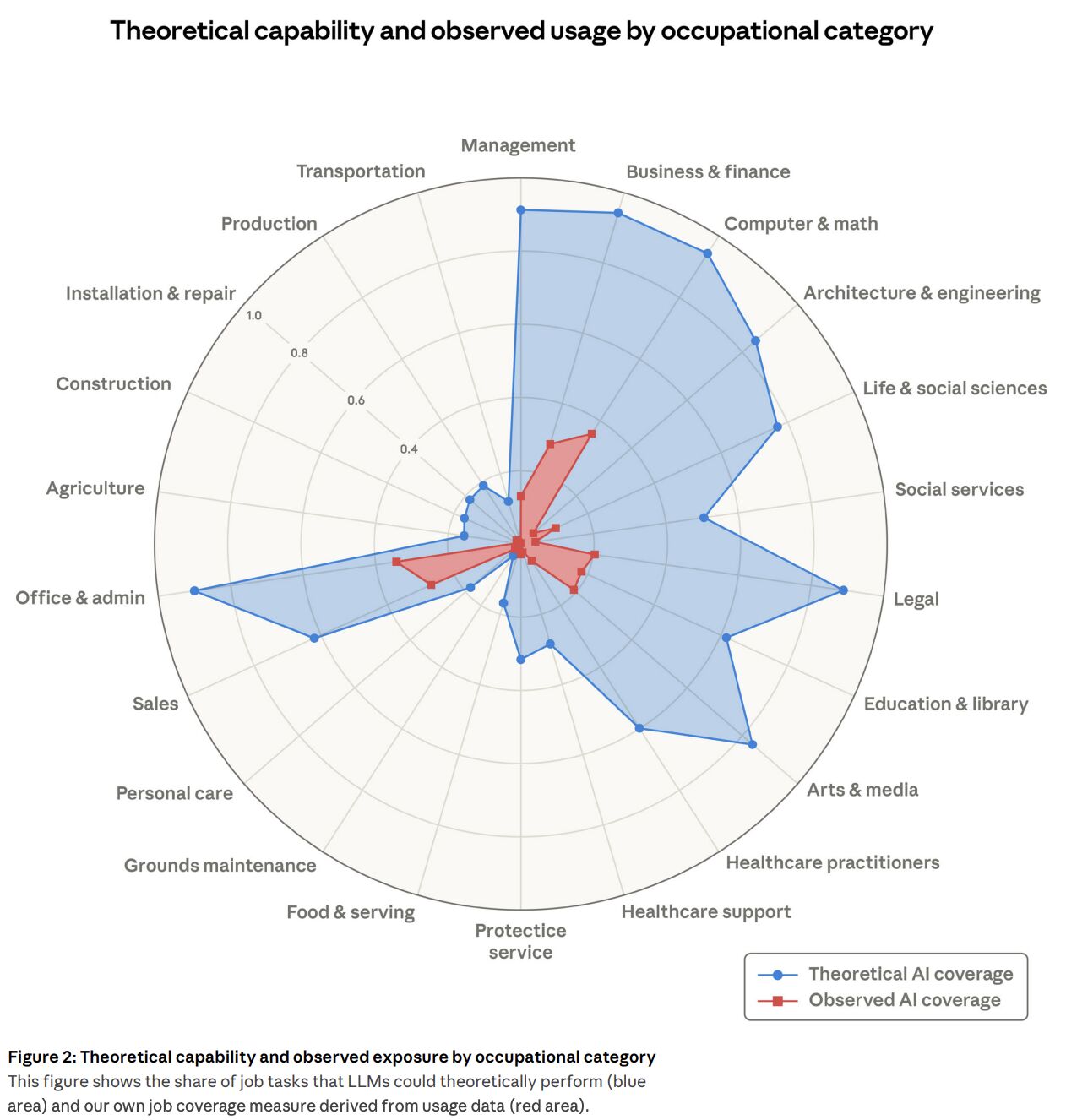
AI-First Path is an AI-first expert assessment, mentorship and corporate training program. A 45-60 minute AI-led voice assessment scores how an engineer or expert actually builds with AI across ten AI-native engineering areas - from coding agents and agent orchestration to system design - and every result is reviewed by our CTO & Principal Engineer Network. Hands-on AI-First Expert Trainings and a 24/7 AI Expert Mentor then close the gaps the assessment found, and a re-assessment against the same rubric shows what improved.
Two groups. Companies - CTOs, VPs of Engineering and L&D leads - who want their engineering and expert teams to become AI-first and need to know where each team stands and what to train. And individual engineers and experts who want an honest, practitioner-reviewed read on their AI-native practice and a concrete path to level it up.
Every engagement starts with a baseline assessment of each participant. The training plan is then built from the measured gaps of your team, drawing on ten hands-on modules mapped one-to-one to the scorecard: coding agents in daily practice, specifications and reusable skills, agent orchestration and context, AI code review and quality gates, MCP and external tool integration, agent isolation and human oversight, AI adoption and team communication, system design for AI-native systems, ownership and learning loops, and collaboration with stakeholders. Sessions are practical and built around your stack and workflows, participants keep their AI Expert Mentor between sessions, and a re-assessment closes the cycle.
Ten areas that separate people who use AI from people who build AI-native workflows: coding agents such as Claude Code and Codex; specifications and reusable skills; agent orchestration and context management; AI code review and quality gates; MCP and external tool integration; agent isolation and human oversight; AI adoption and team communication; system design and architectural judgment; ownership, self-awareness and learning; and collaboration and stakeholder communication. Each scored area must cite at least one verbatim quote from the assessment transcript - areas the conversation never reached are returned as Unverified rather than estimated - and the finished scorecard is reviewed by a practising CTO or Principal Engineer.
No hiring, no recruiters, no marketplace. AI-First Path is built for development only: assessment results are never shared with other companies and are not used to screen, rank or match candidates. In a corporate program, your company receives a team-level capability map and the training plan built from it; individual scorecards stay with the expert, who can choose to share them. That privacy is deliberate - people learn faster when an assessment is safe to be honest in.
Two layers. The 24/7 AI Expert Mentor is an always-on chat and voice mentor connected to your own scorecard, so coaching targets your real gaps - what to practise, in what order, and what evidence would move each score. On top of that, our CTO & Principal Engineer Network - agentic AI builders with strong software engineering backgrounds - reviews every assessment and brings practitioner judgment that generic courses and chatbots cannot.
With the same instrument before and after. Participants are assessed against fixed rubric anchors at the start, and re-assessed against the same anchors after the program. Because every score is backed by verbatim evidence, the change per area is traceable rather than a satisfaction survey or a quiz result - and the team-level map shows where the organisation moved and what to focus on next.
AI-First Path is built in Berlin and GDPR-native by design: experts can request complete deletion of their profile, assessment transcripts and all associated data at any time under GDPR Article 17, and export their data under Article 20. Assessments follow EU AI Act principles - human oversight by a CTO or Principal Engineer on every result, scores traceable to verbatim evidence, auditable records - and are audio-only, with no camera and no facial analysis. For companies, structured AI-first training also supports the AI literacy obligation in Article 4 of the EU AI Act (Regulation (EU) 2024/1689).
Companies can book a team assessment - we start with a short scoping call, then baseline the team. Individual experts can request early access to the assessment and mentor. Because every assessment is reviewed by our CTO & Principal Engineer Network, we onboard deliberately rather than all at once. AI-First Path is built in Berlin, Germany, and is backed by Nvidia, ElevenLabs and Sentry.
Find out where your engineers and experts really stand, train exactly what moves them forward, and prove the lift - with practitioners reviewing every step.